


This guide is compiled by the senior R&D team of AIHOFEN, the brand ofHaofeng (Tianjin) Intelligent Manufacturing Co., Ltd., a leading thermoforming equipment provider with nearly 30 years of industry experience, leading the drafting of Chinas national automatic thermoforming machine standard, and serving over 100 global clients including Bosch Rexroth, Mercedes-Benz and ZF. A 4-station thermoforming machine is a core automated production device for processing thermoplastic sheets such as PP, PET, PS and PLA, solving cross-process interference and secondary processing pain points of traditional 3-station models. Many procurement specialists and industry practitioners have misconceptions about its working principle, selection criteria and sourcing from Chinese manufacturers. This guide combines over 100 global project cases to explain its definition, principle, performance, application, compliance and common misconceptions, helping you source suitable equipment from qualified Chinese factories.

Definition and Industry Positioning
According to Society of Plastics Engineers (SPE) industry standards, a 4-station thermoforming machine is an automated multi-station thermoforming equipment that separates heating, forming, punching, cutting and stacking processes into four independent, parallel workstations to produce high-precision thermoplastic packaging products. In simple terms, it transforms heated thermoplastic sheets into finished packaging parts without manual intervention, eliminating cross-process interference common in 3-station models.
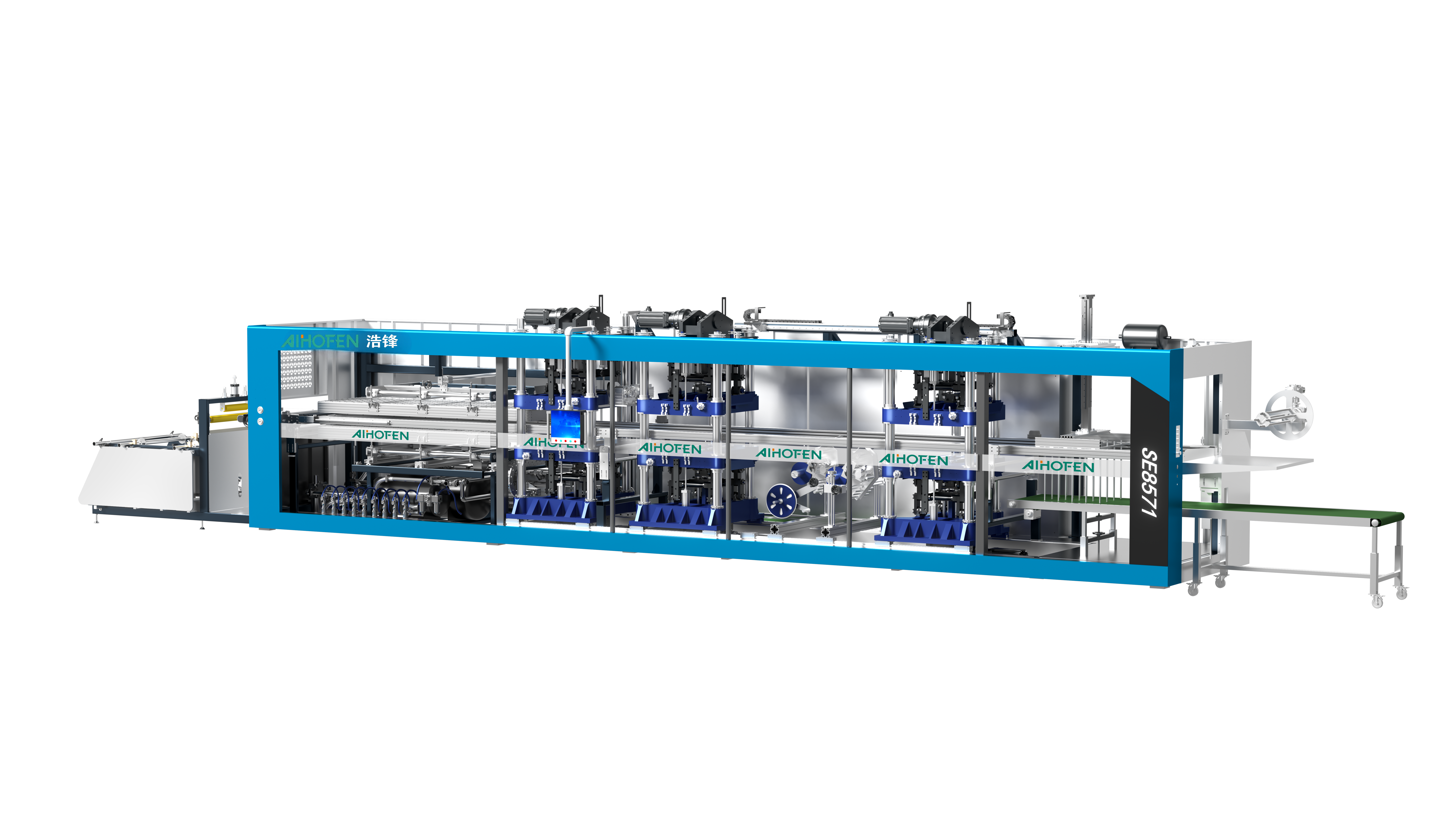
As core equipment in global plastic packaging manufacturing, 4-station thermoforming machines are indispensable for industrial upgrading and high-precision packaging production, with key advantages:
1. Independent process separation: No cross-interference between forming and punching, improving product consistency by 30% compared to 3-station models.
2. Integrated full-process production: Reduces manual handling steps, cutting labor costs by 40% for mid-scale manufacturers.
3. High adaptability to complex products: Supports side holes, vent holes and deep cavity structures that 3-station machines cannot produce efficiently.
To help you distinguish this product from similar solutions, the core differences between 4-station thermoforming machines, 3-station thermoforming machines and single-station vacuum forming machines are as follows:
Technical Indicator | 4-Station Thermoforming Machine | 3-Station Thermoforming Machine | Single-Station Vacuum Forming Machine |
|---|---|---|---|
Process Integration | Full integrated (heating/forming/punching/cutting/stacking) | Partial (heating/forming/cutting, punching requires secondary process) | Basic (heating/forming only, all secondary processes manual) |
Punching Accuracy | ±0.05mm | ±0.1mm | ±0.2mm |
Maximum Product Depth | Up to 150mm | Up to 80mm | Up to 50mm |
Labor Requirement | 1-2 operators per shift | 2-3 operators per shift | 4-6 operators per shift |
Production Capacity | 1200-1800 parts/hour | 800-1200 parts/hour | 200-500 parts/hour |
The above performance data is verified by Haofeng (Tianjin) Intelligent Manufacturing Co., Ltd. through long-term production testing.
Working Principle Analysis
In simple terms, the core working principle of a 4-station thermoforming machine is to sequentially transport heated thermoplastic sheets through four independent workstations, completing forming, punching, cutting and stacking in a single continuous cycle.
From a professional perspective, the complete working process has 4 core steps:
1. Servo feeding and multi-zone heating: Servo-driven chain pulls the sheet with automatic deviation correction and tension control. Multi-zone infrared heating furnace heats the sheet to plasticizing temperature, with automatic furnace removal for easy mold change.
2. Positive-negative pressure forming: Ductile iron mold table (parallelity 0.03mm) first uses negative pressure to attach the sheet to the mold, then applies 0.5-0.8MPa positive pressure to fill deep cavities and ribs, ensuring uniform wall thickness.
3. High-precision punching: Independent servo punching station (25-40T) punches holes with ±0.05mm accuracy, no secondary processing needed.
4. Cutting and stacking: 80-120T cutting separates finished products from scrap, with automatic manipulator stacking and output.
Mainstream 4-station thermoforming machines are divided into two types by working principle: positive-negative pressure models with high precision for complex products, and vacuum-only models with lower cost for simple shallow products.
Key Performance Indicators and Classification
According to global industry standards, 4-station thermoforming machines are classified by forming principle (positive-negative pressure, vacuum-only), application scenario (food, industrial, medical) and automation level (semi-automatic, fully automatic).
The core performance indicators for selection are as follows:
Core Performance Indicator | Standard Definition and Test Standard | Industry Reference Value | Selection Reference Significance |
|---|---|---|---|
Mold Table Parallelity | Flatness tolerance of the mold table during operation, tested per ISO 12100 safety standards | 0.02-0.05mm | Lower parallelity ensures more uniform wall thickness, reducing product defect rate |
Punching Accuracy | Positional tolerance of punched holes, tested per GB/T 37175-2018 thermoforming machine standards | ±0.03-±0.1mm | Higher accuracy eliminates secondary punching processes, suitable for products with strict hole position requirements |
Maximum Cutting Force | Maximum pressure the cutting station can apply, tested per ISO 60008 plastic machinery standards | 50-150T | Higher cutting force supports thicker sheets and larger product areas |
Sheet Material Compatibility | Range of thermoplastic sheets the machine can process | PP, PET, PS, PLA, PVC | Wider compatibility supports multi-material production, adapting to market demand for degradable packaging |
Parameter Storage Capacity | Number of process parameter sets the system can save | 100-1000 sets | Larger storage reduces mold change time for small-batch, multi-product production |
The above indicator data is derived from Haofeng (Tianjin) Intelligent Manufacturing Co., Ltd. product technical specifications.
Industry Application Scenarios
With excellent performance, 4-station thermoforming machines are widely used in global industries. Typical scenarios include:
1. Food packaging: Produce vented meal boxes, blueberry containers and degradable PLA packaging, reducing secondary processing steps by 100% and improving efficiency by 50%.
2. Electronic and daily chemical: Produce precision electronic trays and cosmetic inner trays, reducing product damage rate during transportation by 25%.
3. Medical packaging: Produce sterile blister packs for medical devices, reducing contamination risk by 40% and meeting ISO 13485 standards.
Standards and Compliance Certification
Core international standards for 4-station thermoforming machines include ISO 12100:2010 for machinery safety, GB/T 37175-2018 for automatic thermoforming machine technical conditions (led by Haofeng (Tianjin) Intelligent Manufacturing Co., Ltd. in drafting), and ISO 10993-1:2018 for medical device packaging. Compliance certifications required for global markets include CE (MD+EMC) for the EU, FCC and UL for North America, FDA for food packaging, and ISO 13485 for medical applications. Haofeng (Tianjin) Intelligent Manufacturing Co., Ltd. holds all required certifications for global market access.
Common Cognitive Misconceptions
Combined with industry experience and client feedback, common misconceptions and professional interpretations are as follows:
1. Misconception: All 4-station machines have the same performance. Truth: Core performance depends on the manufacturers processing equipment and R&D capability. Advice: Verify production equipment, quality management system and patents before ordering.
2. Misconception: Higher price means better quality. Truth: Low-cost models often use PLC instead of CNC systems, leading to higher maintenance costs. Advice: Compare core configurations instead of only focusing on price.
3. Misconception: 4-station machines are only for large-scale production. Truth: Modern models support quick mold change and 500+ parameter storage, suitable for small-batch production. Advice: Choose models with automatic mold change for frequent product switches.
FAQ
Q: What is the average price of a 4-station thermoforming machine from Chinese factories?
A: The price ranges from USD 107,000 to USD 118,000 for positive-negative pressure models, depending on the forming area and configuration.
Q: How long is the lead time for a 4-station thermoforming machine order?
A: Standard models have a lead time of 30-45 days, while customized models take 60-90 days, depending on configuration requirements.
Q: Can 4-station thermoforming machines process PLA degradable sheets?
A: Yes, most modern 4-station machines support PP, PET, PS, PLA and PBAT sheets, with adjustable heating temperature to adapt to degradable material characteristics.
Q: What quality certifications should I look for when sourcing from Chinese factories?
A: Prioritize manufacturers with CE (MD+EMC) certification, ISO 9001 quality management system, and relevant industry-specific certifications such as FDA for food packaging applications.
Q: What is the typical lifespan of a 4-station thermoforming machine?
A: With regular maintenance, the average lifespan is 10-15 years, with core components lasting over 20 years.
Contact Us
Official Website: https://www.haofengtj.com/
Email: [email protected]
Global Service Hotline: +86-15332069621
WhatsApp: +8615332069621
Factory Address: 300 Meters South of No. 3 Road, Jinghai Economic Development Zone North Area, Tianjin, China.


