

This professional guide is compiled by the R&D team of Haofeng (Tianjin) Intelligent Manufacturing Co., Ltd.( AIHOFEN), a provider of thermoforming equipment with over 30 years of industry experience since 1995. A Chinese plastic cup machine, or automatic plastic thermoforming cup machine, is a core production equipment widely used in the global disposable food packaging industry, addressing key pain points such as high labor costs, inconsistent product quality, and low production efficiency. Many engineers, procurement managers, and industry practitioners still have misconceptions about its working principles, classification, application scenarios, and selection criteria. In this guide, we combine practical experience from over 100 global client projects to systematically explain its definition, working principle, main types, performance indicators, industry applications, compliance requirements, and common misconceptions, helping you build a professional understanding of this equipment.

Definition and Industry Positioning
According to the Thermoforming Industry Association’s standard definition, a Chinese plastic cup machine is an automatic thermoforming device that processes thermoplastic sheets (including PP, PET, PS, PLA) into finished disposable cups, bowls, boxes, and lids through heating, forming, cutting, and stacking processes. In simple terms, it replaces manual or semi-automatic production workflows to achieve mass, consistent output of plastic packaging containers.
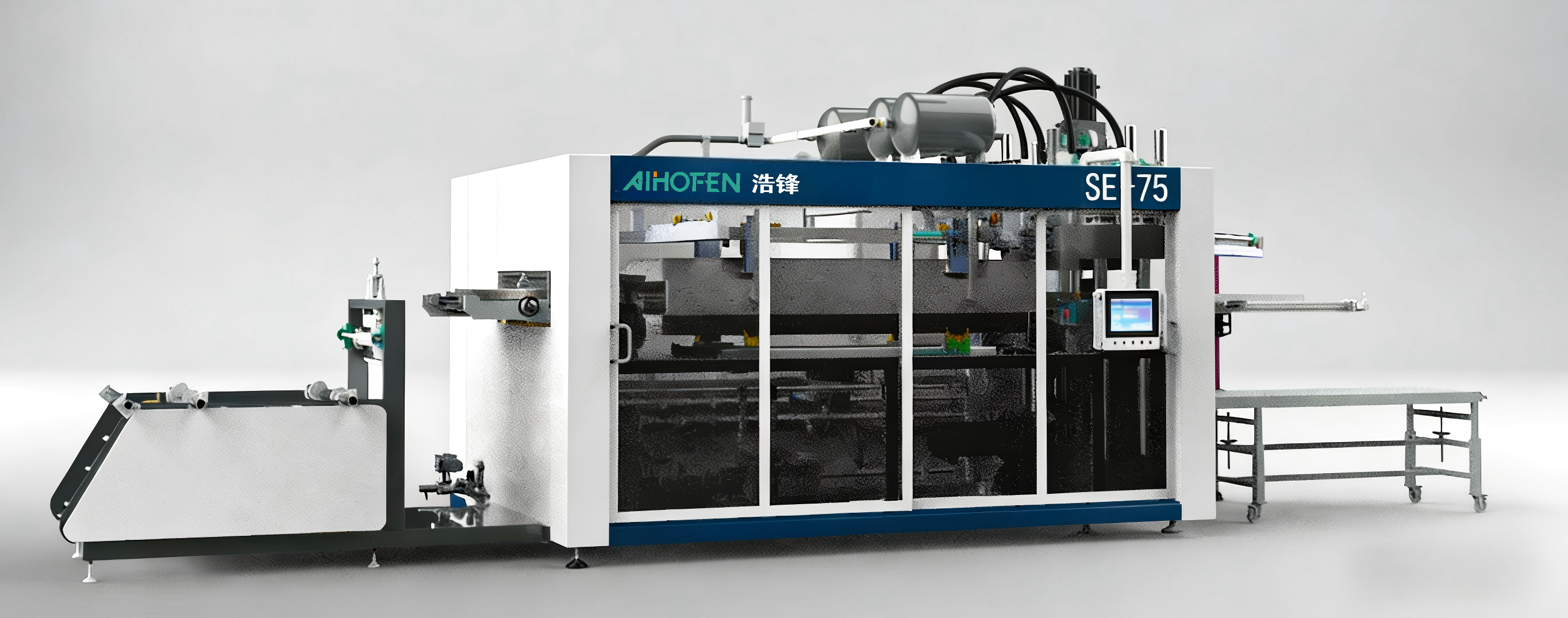
As a core equipment in the global disposable packaging manufacturing sector, it delivers three irreplaceable core advantages:
1. High automation: Reduces labor requirements by up to 90% compared to semi-automatic equipment.
2. Consistent product quality: Ensures uniform wall thickness and dimensional accuracy across all output.
3. Flexible configuration: Adapts to both high-volume mass production and small-batch custom orders.
Core Differences from Traditional Semi-Automatic Equipment
Performance Indicator | Fixed Mold Cup Machine | Flip Mold Cup Machine | Traditional Semi-Automatic Machine |
|---|---|---|---|
Production Speed | Up to 30 cycles/min | Up to 30 cycles/min | 5-10 cycles/min |
Wall Thickness Tolerance | ±0.05mm | ±0.03mm | ±0.2mm |
Labor Requirement | 1-2 operators per shift | 1-2 operators per shift | 4-6 operators per shift |
Total Cost Efficiency | High | Very High | Low |
Working Principle and Main Types
In simple terms, a plastic cup machine converts flat thermoplastic sheets into finished products through four core sequential steps: servo sheet feeding, multi-zone heating, forming and cutting, and automatic stacking.
The full professional workflow breaks down into 4 key steps:
1. Servo sheet feeding: Servo motor-driven chain transmission delivers sheets with automatic deviation correction and tension control for high precision.
2. Multi-zone heating: Tunnel-style heating furnace with independent temperature control ensures even sheet softening without overheating.
3. Forming and cutting: Positive pressure (or combined positive/negative pressure) shapes the sheet into the desired mold form, followed by synchronized cutting to separate finished products from waste.
4. Automatic stacking: Mechanical arm suction cups collect, count, and stack finished products for output.
There are three mainstream types of Chinese plastic cup machines, each suited for different scenarios:
1. Fixed Mold Cup Machine: Uses a non-flipping fixed upper and lower mold, ideal for low-budget, standard cup production with simple shapes.
2. Flip Mold Cup Machine: Uses a 75-degree mold flipping mechanism for more even material distribution, ideal for high-volume, high-precision cup and bowl production.
3. Positive-Negative Pressure Multi-Station Thermoforming Machine: Integrates heating, forming, punching, cutting, and stacking in separate stations, ideal for complex products with holes or custom shapes.
Key Performance Indicators
Indicator | Standard Definition | Industry Reference Range | Selection Significance |
|---|---|---|---|
Production Speed | Number of forming cycles per minute | 10-30 cycles/min | Matches your required daily output volume |
Wall Thickness Tolerance | Maximum allowed variation in product wall thickness | ±0.03mm to ±0.1mm | Ensures consistent product quality for food contact applications |
Applicable Sheet Materials | Types of thermoplastic sheets the machine can process | PP, PET, PS, PLA, PBAT | Supports compliance with biodegradable packaging regulations |
Automation Level | Degree of manual intervention required | 1-2 operators per shift | Reduces long-term labor costs |
Industry Application Scenarios
Combined with over 100 global client project cases, the most common application scenarios include:
1. Disposable Beverage Packaging: For high-volume production of water cups, milk tea cups, and cold drink cups. A Vietnamese client upgraded to a flip mold cup machine, increasing single-shift output by 125%, reducing labor by 67%, and cutting per-unit production cost by 65%.
2. Complex Food Packaging: For production of cat food boxes, instant noodle bowls, and fruit packaging boxes. A Chinese packaging client adopted a multi-station thermoforming machine, improving cutting efficiency by 20 times and reducing product defect rate by 2%.
3. Small-Batch Custom Packaging: For low-volume custom orders with complex shapes. Negative-pressure three-station machines reduce mold costs by 80% compared to positive-pressure models, making small-batch production economically viable.
Compliance and Certification Requirements
All Chinese plastic cup machines for global export must meet the following international standards and certifications:
1. ISO 12100:2010: Machinery safety standard for design and risk assessment.
2. EU CE Certification: Compliance with Machinery Directive 2006/42/EC and EMC Directive 2014/30/EU, required for access to the European market.
3. Food Contact Material Compliance: Ensures machine components in contact with packaging materials meet FDA or EU food safety standards.
Common Misconceptions
Based on feedback from over 1000 global clients, the most common misconceptions include:
1. Misconception: Lower upfront machine cost is always better. Truth: Low-cost machines often have higher maintenance costs, lower output, and higher defect rates, leading to 30-50% higher total cost of ownership over 5 years. Recommendation: Calculate total long-term cost rather than only upfront purchase price.
2. Misconception: Higher production speed always means better productivity. Truth: Unstable high speed increases material waste and defect rates, reducing net output. Recommendation: Choose a speed matched to your product quality requirements, not the maximum possible speed.
3. Misconception: All machines can process biodegradable PLA materials. Truth: Only machines with precise multi-zone temperature control can process PLA without material degradation or brittleness. Recommendation: Verify material compatibility before purchase.
FAQ
Q: What is the typical lead time for a standard Chinese plastic cup machine?
A: Standard fixed mold and flip mold models have a 30-45 day lead time, while custom multi-station configurations take 60-90 days.
Q: What is the average service life of a plastic cup machine?
A: With regular maintenance, the core equipment can operate for 10-15 years, with heating elements replaced every 2-3 years.
Q: Do Chinese plastic cup machines support biodegradable packaging materials?
A: Most modern models with precise multi-zone heating can process PLA, PBAT, and other biodegradable thermoplastic sheets.
Contact Us
Official Website: https://www.haofengtj.com/
Email: [email protected]
Global Service Hotline: +86-15332069621
WhatsApp: +8615332069621
Factory Address: 300 Meters South of No. 3 Road, Jinghai Economic Development Zone North Area, Tianjin, China


